




Partenaires commerciaux agréés (ATP)
Partenaire commercial autorisé
OneScan Pharmacy Pro centralise toutes les exigences de la DSCSA au sein d'un système unique, destiné aux pharmacies ainsi qu'à tout autre type de dispensateur.



.webp)


%201.webp)



%201.webp)




La sérialisation n'est pas une solution universelle. Avec des mandats variés aux États-Unis, dans l'UE, en Asie et au Moyen-Orient, les entreprises doivent faire face à un réseau complexe d'exigences. Êtes-vous prêt pour la conformité mondiale ?
.avif)
Si vous souhaitez faire la différence et vous épanouir dans un environnement collaboratif, LSpedia est l'endroit qu'il vous faut.

A recap of the 2026 LSPedia Logistics Forum covering the year's sharpest DSCSA compliance shifts: a tenfold jump in FDA 483s in 2025, the first DSCSA warning letter issued to a dispenser, and the small dispenser deadline moved to November 27, 2027 with all other obligations unchanged. Also covers what pharmacies miss and NDC 12 readiness.
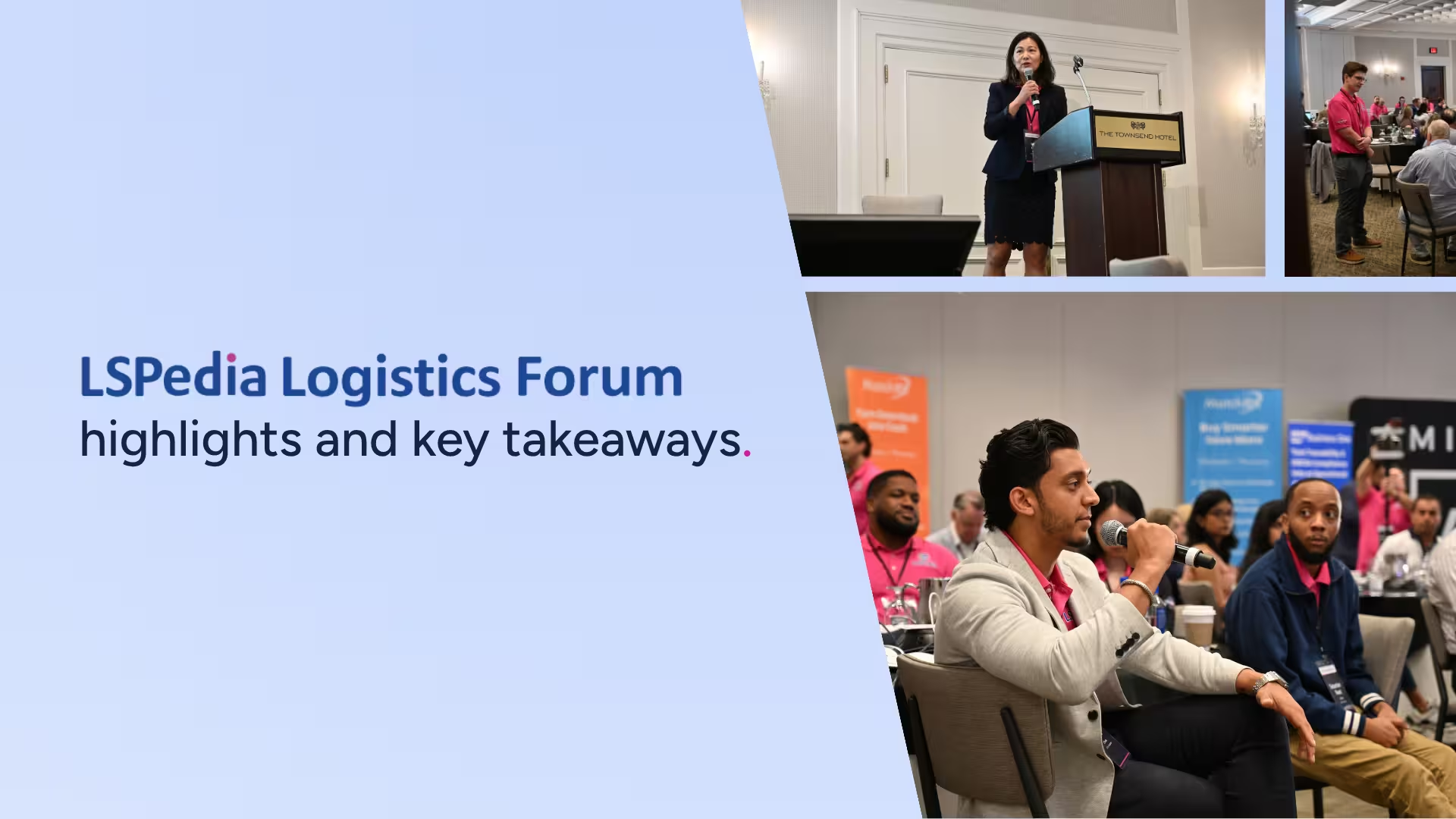
FDA 483s jumped tenfold in 2025, the first DSCSA warning letter to a dispenser went to a medical spa and the small dispenser deadline moved without changing anything else. What came out of the 2026 LSPedia Logistics Forum.
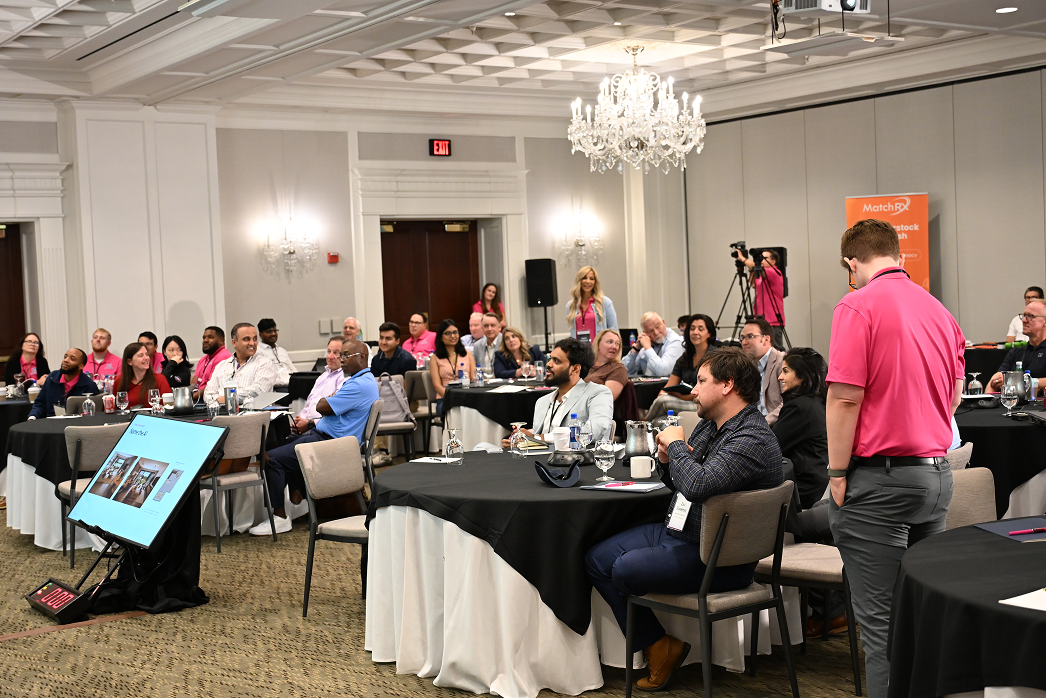
For three days in August, manufacturers, wholesalers, 3PLs, health systems and pharmacies came to Birmingham, Michigan for the second annual LSPedia Logistics Forum. LSPedia CEO Riya Cao set the framing on the first morning: this is not a trade show, it is a room of stakeholders working out how to collaborate. Here is what came out of it.
The keynote came from Abha Kundi, Counsel at ArentFox Schiff, who brings ~15 years of FDA experience including a team lead role in the Center for Drug Evaluation and Research (CDER) Office of Compliance.
The numbers make the shift concrete. Sixteen DSCSA 483s appear in publicly available FDA enforcement documents between July 2018 and March 2026, and the distribution is the story: one in 2018, none for three years, one in 2022, none in 2023, one in 2024, then 11 in 2025 and two more in the first quarter of 2026. Twelve went to manufacturers, three to wholesale distributors, one to a dispenser.
Four DSCSA warning letters have been issued. Three went to wholesale distributors between 2019 and 2025, for failures that read as a checklist of the obligations people assume are handled: responding to illegitimate product notifications, quarantining suspect product, keeping six-year records, buying only from authorized trading partners, holding state licensure and answering a regulator’s TI/TS request within one business day.
The fourth changes the picture downstream. In April 2026, the FDA issued its first DSCSA warning letter to a dispenser, and the dispenser was a medical spa. It was cited for transacting outside authorized trading partners, evidenced by a gap between units of a botulinum neurotoxin product purchased and units administered, and for an unlabeled vial found onsite. If your mental model of a DSCSA dispenser is a pharmacy, that letter is worth sitting with.
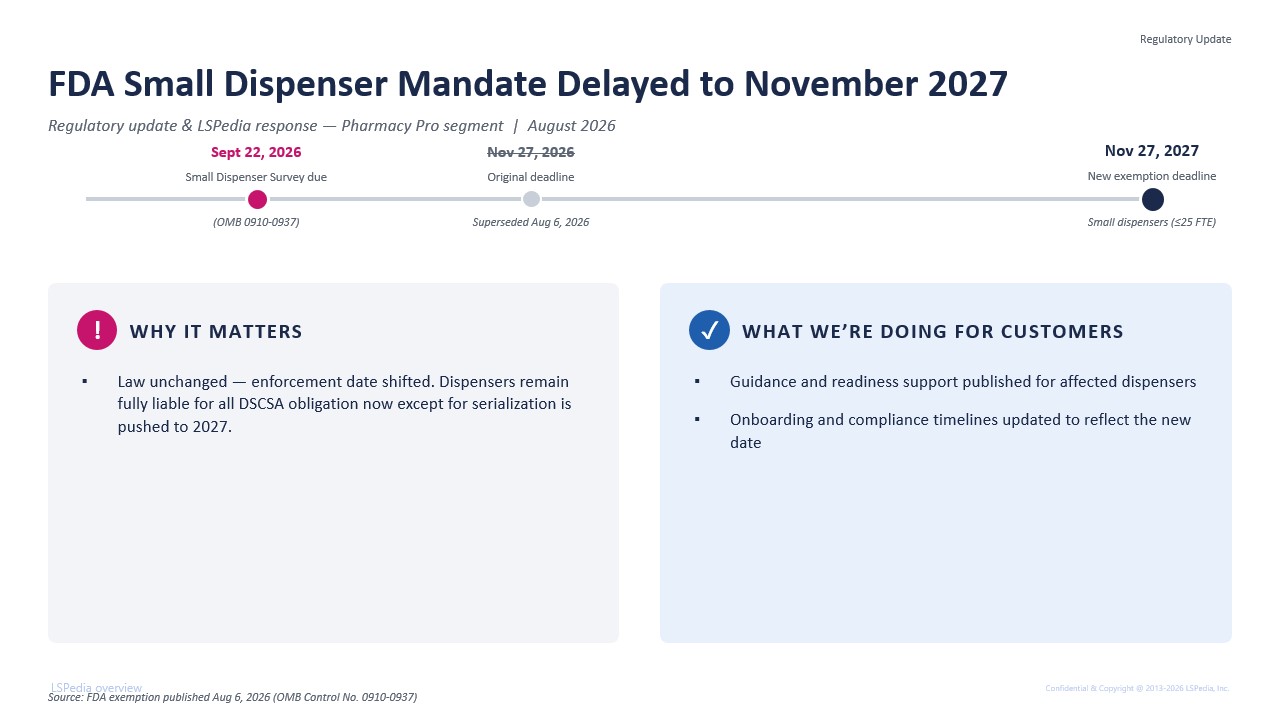
Two weeks before the Forum, FDA extended the small dispenser deadline to November 27, 2027, automatically and with no filing, for dispensers whose owning company has 25 or fewer full-time licensed pharmacists or qualified technicians. Serialization shifted. Every other DSCSA obligation still applies today.
One live deadline is attached: the mandated feasibility survey closes September 22, 2026. What it asks and how long it takes → FDA's DSCSA Small Dispensers Assessment
The most candid hour came from Erin Parsons, Senior Director of Operations & Compliance at LSPedia, with Rony Foumia, Director of Pharmacy Services at Children’s Hospital of Michigan.
Their advice for pharmacies is to continue the pursuit of operational excellence. How can you say that you’re operating at the highest level to protect your community?
Make your entire pharmacy staff knowledgeable on:
1. What is DSCSA?
2. What is your receiving process?
3. What do you do if you doubt a drug’s legitimacy?
4. Where is your quarantine area?
Board inspectors ask the same questions, and they ask a staff pharmacist. DSCSA training is what closes that gap.
Michael Rowe made the same point from the other end of the chain: a quarantine area is paramount, because reverse logistics and DSCSA are now colliding on best practices. Associating a return to the right transaction information is where he sees the most trouble, and too much of it resolves as manual back-and-forth with the pharmacy. Error-proofing that is where he thinks the industry has to go.
Asked on the compliance enforcement panel what trading partners actually expect from each other today, Julian Lopera of PharmaMED gave the shortest answer of the Forum: paid, on time and correct, with a fast response when something breaks. His own customers are expecting the same from him the same day, so everything has to reconcile.
The gross-to-net session took on a premise most organizations have not acted on: serialized movement data is a financial control instrument, and almost nobody uses it as one. The barrier is not technical. The data sits in Quality and the value sits in Finance.
Jeff Gottheim, CIO & Director of DSCSA Serialization at Leading Pharma, described the target state in data terms: serialization numbers at the center of a star schema, with everything else rotating off them. Every transaction, every serial number at every level of aggregation, in one database. When a return comes back he can say what shipped, on what PO, to which customer, at which SGLN. The catch is that his returns processor has to know it too.
The sharpest example came from the finance seat. Jag Rajan, CEO of RXPathways, Inc. pointed out that chargeback data frequently does not carry the lot number, so chargebacks cannot be reconciled against actual product movement, and returns and duplicate discounts tangle on top of that. Without the lot, there is no trace. Add a recall and it gets worse. His underlying problem was blunter still: serialization lives in its own database, at a granularity the ERP cannot absorb, so as a finance person he cannot answer where his bottom line is.
Tushar Gupta, EVP of Operations at LSPedia, drew the conclusion. Without the full picture of the data you already own, reconciling the bottom line is close to impossible, and no two manufacturers have the same tech stack or the same workflows, so whatever gets built has to be flexible.
The 340B session made the same case from a different angle. Ana Schleicher of LSPedia laid out the problem: product moves but the data does not, because some covered entities manage 340B shipments without sending the required EPCIS messages. Her prescription was to move from reactive to proactive across five steps, detect, diagnose, engage, resolve, monitor. And her line echoed the dispenser session almost word for word: if we did not record it, it did not happen.
The closing panel brought together Ullrich Mayeski of GS1, Bruce Harold of KeySource, and LSPedia’s John Monsour and Ilir Ivezaj. Monsour framed the difference from DSCSA: that was phased, and NDC 12 is everybody at once. Mayeski made the point most people miss, that the rule has two parts and the second one, dropping the linear barcode requirement, is where manufacturers are actually starting. Harold’s advice was the most repeated of the session: do your inventory, because the NDC is in more places than you think.
The rule, the dates and the preparation steps in full → NDC 12: the FDA’s 12-digit NDC rule
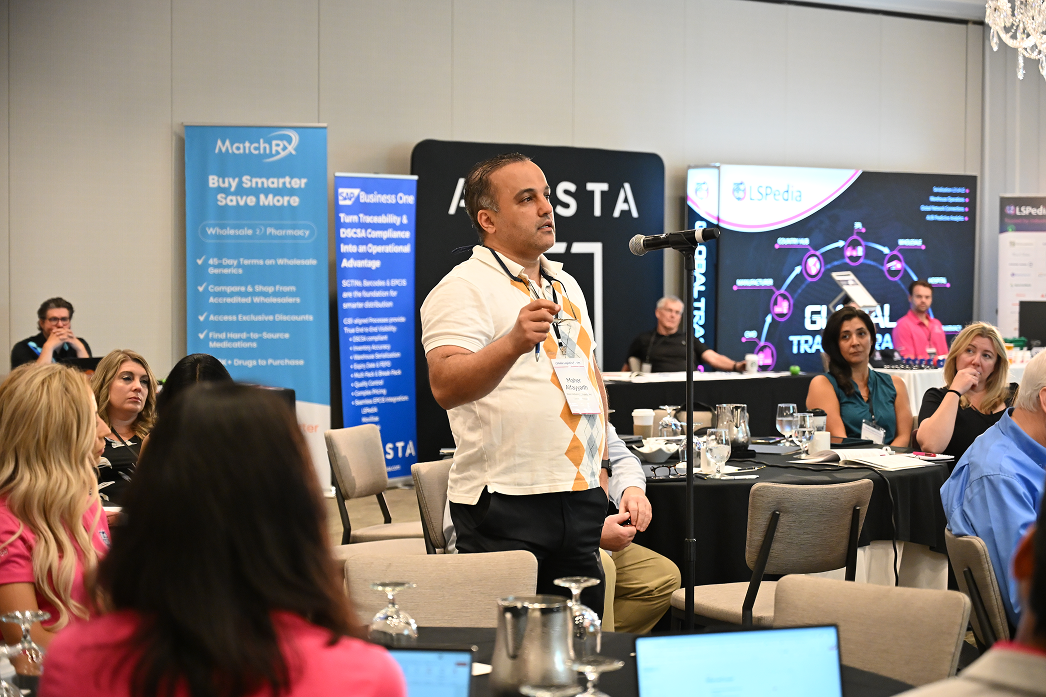
To everyone who cleared two days to be in the room, and also to our Logistics Forum sponsors, Amista and MatchRx.
The tentative date and location for the third annual LSPedia Logistics Forum is August 4, 2027 at the Townsend Hotel. Watch our socials for updates and additional details.